Kirk was born and raised in the lower mainland and graduated from the University of Queensland in Brisbane with a Masters in Physiotherapy in 2016. In Australia he worked out of Alice Springs, servicing remote Indigenous communities across a 1,000 km² area with only one clinic — a caseload that ran from post-operative patients and athletes to stroke and chronic pain.
He later took a mentorship with Diane Lee in South Surrey and became well versed in the Integrated Systems Model, which is now foundational to how he assesses and treats. His postgraduate training includes dry needling, vestibular and concussion rehabilitation, and golf-specific assessment.
Kirk works with amateur athletes, weekend warriors and anyone pursuing a more active life, whatever their starting fitness. Outside the clinic he plays soccer, hockey and golf, and enjoys camping, hiking and travelling.
Courtney was born and raised in Summerland and graduated with a Masters in Physiotherapy from the University of Queensland in 2016. As a new graduate she worked alongside two titled Sports Physiotherapists in Alice Springs before returning to Canada.
She is certified in the Integrated Systems Model of care and was mentored by its founder, Diane Lee. Most recently she worked at Delta Health and Performance, including the Delta Wild Hockey Academy, treating elite hockey players across all ages and skill levels.
Through Delta Health she became a consultant physiotherapist for local NHL, WHL and AHL players during the COVID shutdown and their off-seasons.
Brittany grew up in Edmonton and has always been active — weightlifting, CrossFit, running and time on the trails. Her background as both athlete and coach gives her a working understanding of sports injuries, performance, and what it takes to move and feel your best.
She completed her Doctor of Chiropractic and a Master's in Sports Medicine at the University of Western States, and has extensive experience with patients recovering from pain, injury and long-standing movement problems. Her approach blends hands-on soft tissue therapy, individualised rehabilitation exercise and chiropractic adjusting.
Outside the clinic you will usually find her lifting, running, or out on the trails with her dog, Kenai.
About chiropractic care →
Kelsey is the clinic's kinesiologist, working with patients on exercise therapy that builds strength, improves performance and reduces the chance of a repeat injury. She picks up where hands-on treatment leaves off, translating an assessment into a progressive program you can actually keep up with.
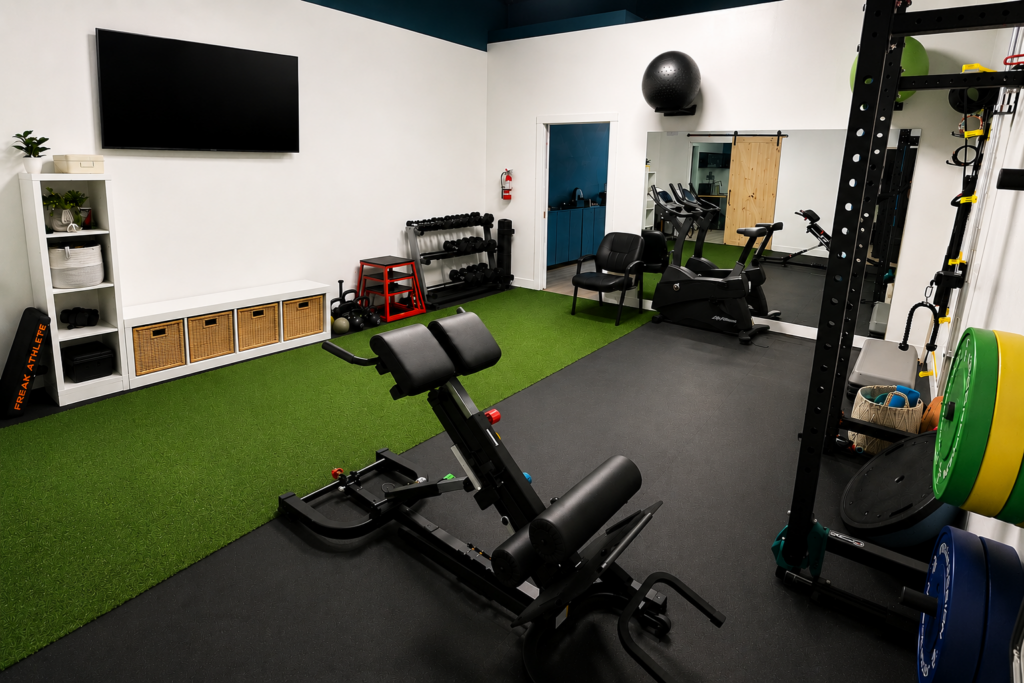
Her sessions run in the rehab gym, using the turf and strength equipment to load movement patterns properly rather than sending you home with a sheet of exercises.
Rozalind is a newly registered massage therapist offering care in her hometown of Summerland. Her interest in helping others started early and has grown into a lasting commitment to health, wellness and compassionate support.
A background in soccer, volleyball and dance gave her an appreciation for the body's resilience and the role of movement in healing. She is especially interested in craniosacral therapy, myofascial release and trauma-informed care, and enjoys supporting clients through pregnancy massage and TMJ-focused treatment.
Outside the clinic she hikes, camps, practises Pilates, reads, and spends time in nature and with the people she loves.
Every course of physiotherapy here starts with a full body assessment. We look for the movement impairments limiting your goals rather than treating only the spot that hurts, which is why the area we work on is not always the area that brought you in.
Treatment combines hands-on techniques with active rehabilitation, and you leave with specific things to do between visits. People commonly come to us for back and neck pain, post-operative recovery, sports injuries, and pain that has not settled with rest.
Initial assessments run 45 to 60 minutes. Follow-ups are 30 minutes, or an extended hour where the problem warrants it.
Dr. Brittany Hutcheon blends chiropractic adjusting with soft tissue therapy and individualised rehabilitation exercise, so improvements hold between visits rather than resetting each time.
Her background as an athlete and coach, alongside a Master's in Sports Medicine, shapes an approach built around returning you to the activity you actually care about.
Common reasons to book include neck and low back pain, joint stiffness, neck-related headaches, and long-standing movement problems that have not responded to rest.
About chiropractic care →
Kinesiology picks up where hands-on treatment leaves off. Sessions run in the rehab gym, using the turf and strength equipment to load movement patterns properly rather than sending you home with a sheet of exercises.
Programs are progressive and built around your goal, whether that is returning to sport, rebuilding after surgery, or getting strong enough that an old injury stops recurring.
Kinesiology often runs alongside physiotherapy, with both providers working from the same plan and the same notes.
Rozalind Neves offers therapeutic massage aimed at reducing tension, easing pain and supporting recovery.
Her particular interests are craniosacral therapy, myofascial release and trauma-informed care. She also offers pregnancy massage and TMJ-focused treatment.
Massage works well on its own, and works well alongside physiotherapy or chiropractic care, particularly when muscle tension is limiting how much range you can hold onto between appointments.
We fit OssKin custom knee braces for ACL, PCL and meniscus injuries and for arthritis, whether you are managing a new injury, returning to sport, or trying to stay active for longer before considering surgery.
Rather than being measured to the nearest size, an OssKin brace is 3D printed from a scan of your own leg, taken here in the clinic. An off-the-shelf brace that does not sit correctly gives support where you do not need it and leaves it out where you do.
Many extended health plans cover part or all of the cost. Bring your policy details and we will help you check before you commit.
About OssKin knee braces →
Exercise-based interventions to promote healing and restore optimal function in athletes. The aim is not just to settle the injury but to get you back to the demands of your sport, at the intensity you left it.
Both of our physiotherapists trained in Australia and have worked with athletes across a wide range of levels — Courtney most recently with elite hockey players at Delta Health and Performance, including consulting for NHL, WHL and AHL players. Kirk works with amateur athletes and weekend warriors, and has completed golf-specific assessment training.
Sessions run in the rehab gym, using the turf and strength equipment to load movement patterns properly rather than guessing at readiness.
Dry needling uses fine, single-use needles placed into tight or irritable muscle to reduce tension and ease pain. Despite the shared tool, it is not acupuncture — the reasoning behind where a needle goes comes from a physiotherapy assessment of your movement and symptoms, not from meridians.
It is used as one part of a session rather than a treatment on its own, alongside hands-on work and the exercises that keep the change. Kirk has completed postgraduate dry needling training.
Most people feel a brief cramp or twitch as a needle goes in, and some muscle soreness for a day afterwards is normal. If you would rather not try it, say so — there is always another way to get at the same problem.
A detailed assessment and history to help identify the reason for your dizziness or vertigo. Dizziness has many possible causes, and the first job is working out which one you are dealing with.
Depending on what the assessment finds, treatment may involve repositioning manoeuvres, gaze and balance retraining, or graded exposure to the movements that currently set symptoms off.
Kirk has completed postgraduate training in vestibular and concussion rehabilitation.
Early detection and treatment within seven days of a concussion is important for a quicker recovery and an earlier return to sport.
Assessment covers symptoms, balance, neck, and the visual and vestibular systems, then builds a graded return-to-activity plan rather than leaving you to wait it out in a dark room.
If you have hit your head and symptoms are worsening, call the clinic or seek urgent medical care first — physiotherapy comes after the red flags are ruled out.
Partially restricting blood flow to a limb during low-load exercise creates a metabolic stress in the tissues that drives muscle growth. Traditionally that growth comes from mechanical stress — lifting heavy. If pain limits how much you can load, blood flow restriction training may be worth trying.
It is particularly useful early after surgery or injury, when the joint will not tolerate heavy weight but you are losing strength by the week.
The cuff is applied and monitored by your therapist during the session. It is not suitable for everyone, so we screen for it before starting.
Real-time ultrasound lets you see the deep core muscle system while it works. Watching the muscle on screen makes it far easier to tell whether you are actually recruiting it, which assists with training and improving recruitment strategies.
It is most useful when an exercise looks correct but is not producing the change it should, and for anyone who has been told to engage a muscle they cannot feel.
This is imaging used for training feedback within a physiotherapy session, not diagnostic imaging and not a replacement for it.